
 Simorgh Publications
Summary
Published in 1995 by Simorgh, Anjana Raza’s The Quilt Book documented the Trinjan Quilt Project by transforming women’s talk and experiences shared during the project into anonymised stories. The project was a collaborative initiative between Simorgh (Women’s Resource and Publication Centre) and the Asian Women’s Human Rights Council. Together, they organized the 1993 tribunal “In the Court of Women” to provide a platform for survivors of violence and to launch the Trinjan Quilt Project, which would create a visual testimony to the violence faced by Pakistani women.
The project was further inspired by a Punjabi folk tale where village women created a shared space of support through weaving, only to be destroyed by men threatened by their power. As part of the Trinjan project, Simorgh co-ordinated and organised quilt-making workshops which also facilitated critical discussions on poverty, human rights and domestic abuse including harrowing accounts of rape, acid burning, and economic neglect. For over a year, women ranging in age from five to seventy created twenty-five quilt-panels – a potent symbol of community building and womanhood. The sessions, led by Anjana Raza, provided a space for women to create visual testimonies of their experiences.
The Quilt Book, composed by Raza, emphasizes social concerns in Pakistan, elucidating that no woman is safe from violence. Beyond documenting the panels, Raza’s poetic prose unravels the psychological toll of various forms of violence, focusing on themes like suicide, isolation and the “shards of silence” that shroud trauma. Through bringing together the narratives of many women of different ages, The Quilt Book aims to break silence, encouraging women to assert themselves and reclaim their identity through creative expression. Ultimately, the quilt, both in this book and in the project, serves as a metaphor of interweaving female lives, sewing together scattered fragments into a protective whole to honor their resistance.
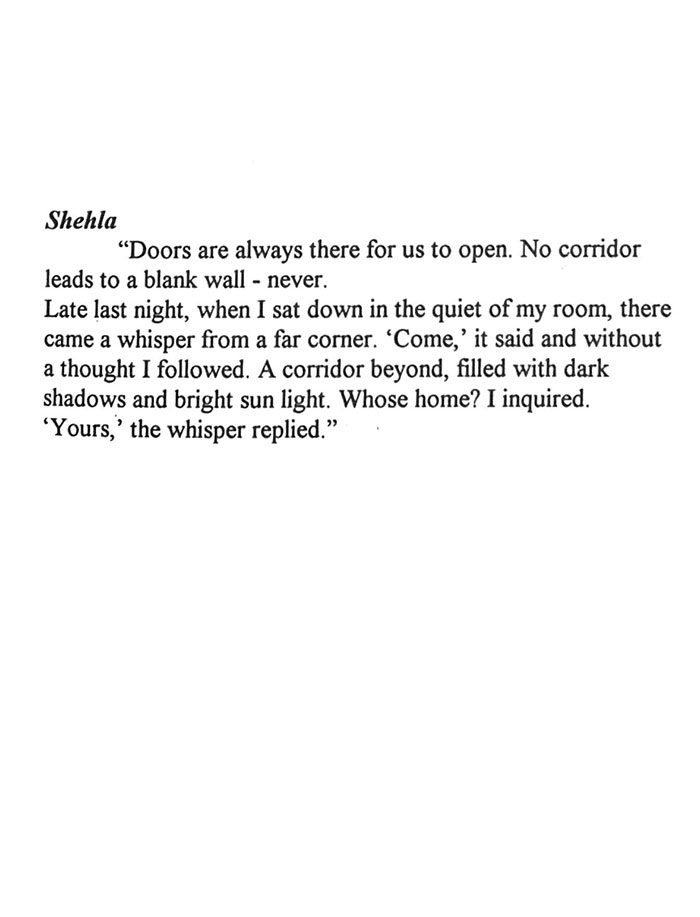
“Shehla”
The brief yet profound poetic narrative titled “Shehla” is a personal journey of hope and self-discovery, emphasizing that doors are always available for those willing to open them. It explores themes of self-discovery, the subconscious and trust in the Divine. The opening metaphor of doors always being there for women like Shehla establishes a philosophy of infinite possibilities and rejects the idea of dead ends in life. The transition from the quiet room to a mystical corridor represents the journey to the internal psyche. By following the whisper, Shehla seems to surrender not only to her intuition but to the Divine. The binaries of darkness and light represent the dual nature of the self. In sum, the revelation of the unknown space as Shehla’s identifies the vast unexplored expanse as Shehla’s soul. Thereby, it inculcates values of optimism, depicting that life has many doors to offer that promises self-discovery and new opportunities.
Shehla’s narrative is selected for this archive to embody the enduring values of hope and renewal, illustrating that even within the “dark shadows” of a corridor, there are always doors available to open. Her journey represents a profound act of resistance against despair, reclaiming a space of belonging that serves as a vital blueprint for self-discovery and personal agency in concurrent times.
Community Comments