
 Simorgh Publications
Summary
The booklet, Hamari Kitaab (“Our Book”) documents a 24-day regional screen-printing workshop held in Lahore in December 1987. It was organized by the Simorgh Women’s Collective, and this event brought together fourteen activists and grassroot workers from Bangladesh, India, Sri Lanka and Pakistan. It was led by the artist Lala Rukh and Shahid Pervaiz. Lala Rukh served as a resource person for the workshop and hosted the entire 24-day event in the garages and backyard of her family home. Moreover, Pervaiz is the second resource person who provided technical guidance throughout the regional workshop. The primary aim of the workshop was to empower women with technical skills to create their own visual materials for not only their consciousness-raising but also for their income. Despite diverse backgrounds and language barriers, the participants developed a non-hierarchical, communal space. This space was further enriched by sharing ideas, poems and images. This environment warmly welcomed a profound emotional bonding and collective identity that broke the chains of political and territorial divisions.
The workshop culminated in a collaborative “godri” (patchwork) poster. Each participant contributed a unique message or image that symbolized their experience. The resulting booklet is more than a record of meetings; it is a manifestation of a new space that celebrates creativity within a supportive regional community.
Both Hamari Kitaab and the Trinjan Quilt Project alongside The Quilt Book used collective art to reclaim feminist history. While Hamari Kitaab focused on screen-printing to empower South Asian activists with “political” publishing skills, the Trinjan Project used quilting as a “visual testimony” to violence. Together, they demonstrate Simorgh’s evolution from teaching technical grassroots mobilization to using traditional domestic crafts to rebuild communal spaces of female solidarity and witness.
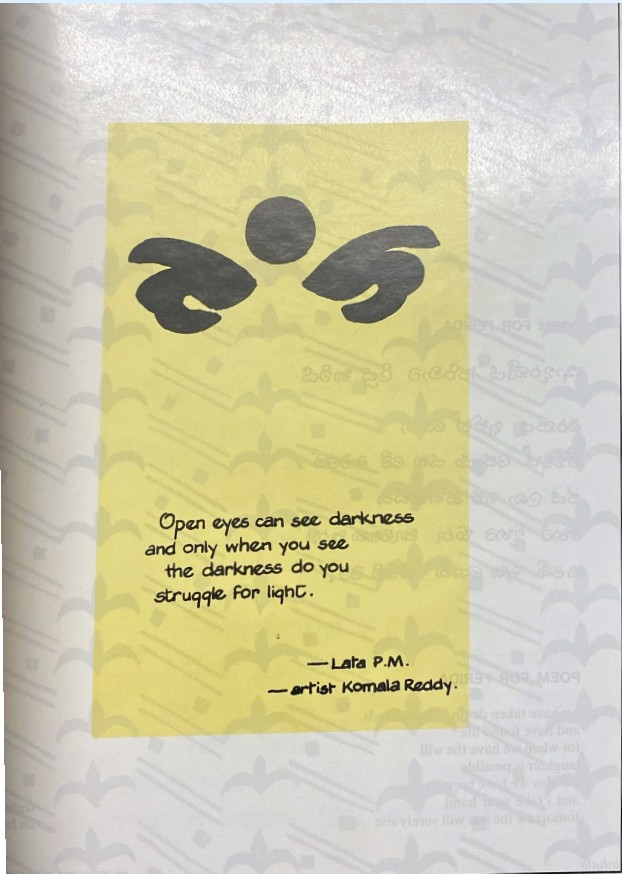
“Poem for Ferida” (p. 35)
Written in Sinhala, the selected poem expresses shared humanity and resilience in the face of suffering. It is a collaborative work by Seetha from Sri Lanka and Monira and Afroza from Bangladesh. Despite the opening line reeking of violence, it followed by a soft taste of hope, thereby balancing opposing forces of death and life. The collective voice (“we”) emphasizes the notion of unity that is the main theme of Hamari Kitab. The final image of the rising sun symbolizes renewal and the inevitability of better days. References to Sri Lanka and Bangladesh broaden the poem’s context, suggesting a universal experience of endurance across cultures.
The poem stands out as a critical highlight because it transforms the solitary experience of suffering into a collective act of defiance, demonstrating that even when language and borders differ, the shared struggle for dignity creates an unbreakable bond.
Community Comments