
 Simorgh Publications
 The Romance of Raja Rasalu and Other Tales
-
Author:
Momina Raza
-
date:
2007
-
Page Range:
10-13
Summary
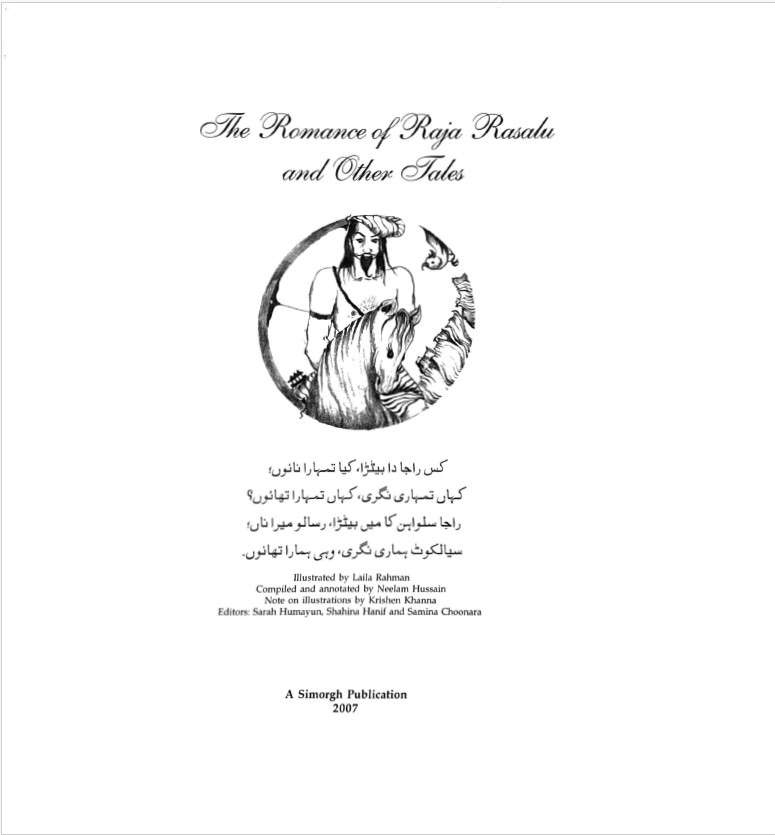
The collection, The Romance of Raja Rasalu and Other Tales, is a vibrant tribute to Punjabi oral folk tradition. It was compiled from the 19th century transcriptions of colonial storytellers like Flora Annie Steel, R.C. Templeton, and Charles Swynnerton. Later, it was compiled and annotated by Neelam Hussain, and published in 2007. These tales explore the legendary hero, Raja Rasalu, whose life of adventure and romance unfolds in a world where the boundaries between humans, fauna and the supernatural are constantly blurred.
Furthermore, this book is not merely based on fairytales; it is a political act to reclaim the cultural rich identity and heritage that was deprecated by the British Raj. The introduction of the book highlights how these tales that were once shared by villagers offer a unique dialogic space where listeners are not only encouraged to listen but also to participate and unravel mysteries. Featuring an array of characters like talking parrots, ghouls and what not, it captures both the classic elements of the folk tradition and their strikingly modern resonance through illustrations by Laila Rehman. Thus, it bridges a gap between the disappearing oral tradition of the past and the digital present. These stories further interweave elements of humour, violence and the joyous ethos of Pakistan to preserve the flamboyant culture of Punjab.
Preserving The Romance of Raja Rasalu and Other Tales is a vital contribution to Pakistan’s publishing history because it represents a “political act” by women to reclaim indigenous narratives from colonial and exclusionary post-independence agendas. Compiled by Neelam Hussain and published by the Simorgh Women’s Resource and Publication Centre, the book showcases a female-led effort to protect oral traditions – originally the “repository of marginalized people such as women” – from being devalued or “sanitised” (xi).
The introduction is specifically important because it reframes these stories as a “dialogic space,” (xii) moving them beyond a passive reading experience into an active, communal one. It emphasizes the desire to return these tales to a space of active engagement. By doing so, the book seeks to restore a “rich heritage” (xii) to the public, taking it out of an “institutionalised enclosure” (xvii) and back into the hands of the storytellers and listeners.
Excerpt from the Introduction (xii)
Pakistan is rich with its culture of oral story tradition, but these traditions are often sidelined in a postmodern digital world. However, Raja Rasula and Other Tales endeavors to not only preserve the oral tradition of folktales, but also to revive it within a dialogic space. This space refers to a communicative environment that breaks the passive, one-way relationship typically found between a text and its reader, or a viewer and a cinema screen. The introduction affirms that while the narrative may lie in the hands of the storyteller and so be governed by their unique memory and trajectory, there is an intimate relationship with its listeners or readers that encourages a more active participation. This dynamic relationship allows for interjections, nods of recognition, and communal questions, transforming the tale from a static text into a living, multi-dimensional experience that preserves the mysterious aura of the original folk tradition.
Community Comments